There are days I hate being on a ketogenic diet. Since my pancreas doesn’t care what I think,
I have to work around that.
Luckily, a reader asked for some ketogenic bento ideas. This got me to thinking more creatively, and
that means meals that don’t make me grind my teeth in frustration.
Building a Good Ketogenic Bento
A good keto-friendly bento has these qualities:
Simple to make
Low in carbohydrate
Tasty and satisfying
Relevant to the day
Simple to make
If something is too difficult, or if it takes too long,[1]
you’re not going to do it consistently.
For me, I want a bento that takes less than five or ten minutes to make. This means I often make use of dinnertime
cooking to throw in something for the bento. I have a small countertop oven that can roast
any meat you care to name pretty easily, so I’ll often put something on while I’m
making dinner. After dinner, before I
clean up the kitchen for the night, I prep the bento.
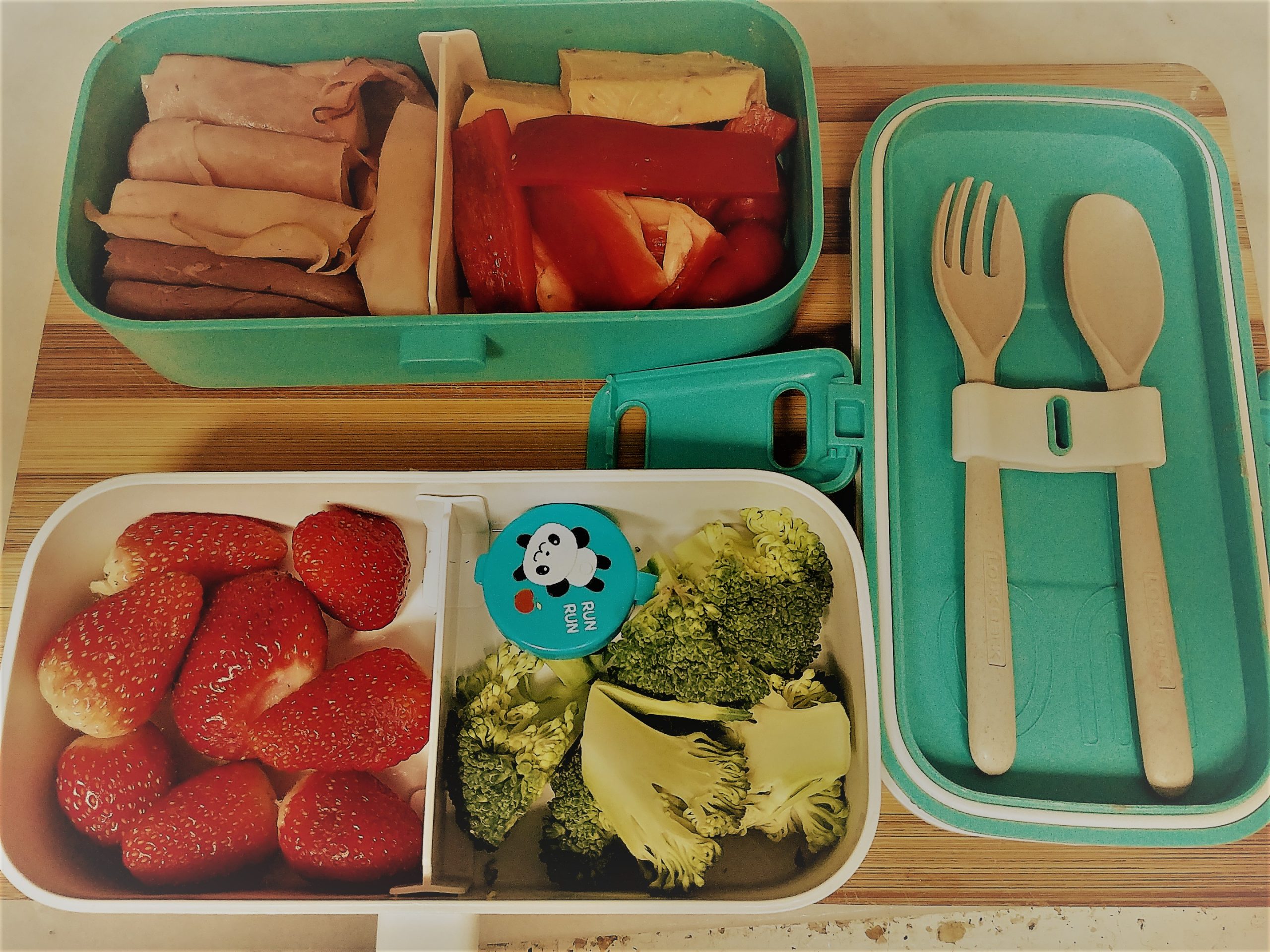
The bento above was unusually time-light. I took six minutes and thirty-eight seconds
to make it.
Low in carbohydrate
That’s a “duh!” moment, right? What you really want for a good keto-friendly
bento is not to be using up too much in the way of carbohydrate, but still
ensuring you’re going to have a nutritious meal. You’ll notice the strawberries and red
peppers are on the higher end of the carbohydrate scale for this meal. You do need to decide how much you want to be
eating per meal, but I find that raw veggies help make a nice lunch, and
strawberries round it out in a way that’s satisfying.
Food
Calories
Carbs
Fiber
Fat
Protein
Sugar
Hormel – Turkey Lunch Meat, 1 slices
15
0
0
0
3
0
Hormel – Roast Beef Lunch Meat, 1 slices
15
0
0
1
3
0
Hormel – Smoked Deli Ham Lunch Meat, 1 slices, 56g
15
0
0
0
3
0
Cheddar cheese, 2 oz
229
2
0
19
13
0
Broccoli, flower clusters, raw, 0.5 cup flowerets
10
2
0
0
1
0
Peppers, sweet, red, raw, 0.5 cup, chopped
23
4
2
0
1
3
Strawberry, 0.5 cup, halves
24
6
2
0
1
4
Kens – Creamy Caesar Dressing, 1 tablespoons
85
1
0
10
1
1
Totals
416
15
4
30
26
8
Net Carbs
11
A low carb bento must be tasty and satisfying
You’re not going to be happy with your lunch if it doesn’t
taste good. You might like different
vegetables and fruits than I do. Many
people who enjoy avocado[2]
find this a good way to make a meal both tasty and satisfying. Fat helps you to feel satisfied, hence the
cheese and dressing dip in this meal.
Also, you need to get enough fat in a ketogenic diet. It’s a lot of your nutritional balance.
Relevant to the day
When you make keto-friendly bento, it’s a good idea to give
some thought about what kind of day you’re going to have. Will you be able to heat up your lunch? Will you need to be able to eat it with your
hands, such as when you’re on the road.
This is an excellent lunch when you’re on the road. You can eat it quite neatly without a fork if
need be.
Instead of a sandwich – verboten on a ketogenic diet, I made
lunchmeat wraps. I take a slice of
lunchmeat with a small, narrow slice of cheese, and wrap the meat around the
cheese. You can experiment a lot
here. A combination my husband and I are
extremely fond of is sliced roast beef wrapped around horseradish cheese. If you like flavored or specialty cheese,
these can be paired well with different deli meats. Pepperoni wrapped around fresh mozzarella is
excellent, as is turkey and smoked gouda.
On days that I might not be traveling, or have time to sit
down at a table like a civilized person, a salad is a common keto-friendly lunch.
When you think about the principles behind the bento you
want to make, you’ll find it is easier to be creative and still stick to a diet
that suits you.
What ideas do you have for a keto-friendly bento?
[1] For
whatever your definition of “too long” happens to be
Do you ever wonder why people stay in dysfunctional relationships? If you’re on Facebook and feeling increasingly unhappy about being trapped because it’s the only way your social circle contacts each other, you don’t need to ask that question. You already know.
You’ll make excuses for it.
You’ll look for the benefits.
Worse, you might actually get some sort of service or support you don’t
think you can get anywhere else.
Why Facebook is Bad
I broke up with Facebook recently. When I say I am done, I mean I deleted my
profile and everything.
I did it for a lot of reasons, but yeah, the cynical contempt of Facebook’s users by the people who own it, and the corruption behind it, are major motivators. To be frank, I was feeling mistreated.
But it’s more than that direct and blatant manipulation. Our interactions are being guided by
advertisements, for pity’s sake! How you
connect to a friend on Facebook who is going through significant emotional
trouble is being used as data to encourage you to look at advertisements and
buy products.
Beyond the very nature of the platform, it is also how Facebook
is encouraging us to communicate.
Or think we’ve communicated.
Many of us post updates on our lives from Facebook and think
we’ve communicated with our friends.
I am increasingly of the opinion that’s not what’s really
happening. What I think is really
happening is that we’re curating newsletters. Well, that and forwarding other people’s
thoughts.[1]
There is a value in curated newsletters, yes – if you’re a
public figure, or manage a large interest group of some sort. I’m not, and I don’t… Not anymore anyway.
Oh, sure, sure, social media can make you feel like
you are some sort of celebrity and that mass communications are the best way to
interact with your fans. And therein
lies the danger.
Please don’t interpret this as saying Social Media is Evil
and Wrong. It’s not. I’ve used the Internet as a way to meet and
develop friendships since the mid-nineties. That means I’ve been using online
communication for about half my life –more like 70% of my adult life. I’ve developed many genuine friendships[2]
on message boards, discussion groups, and other forms of social media.
I think the disconnect comes in when you’re not
messaging people and having conversations personally. Sure, sure, commenting on posts can become
a conversation. So often, however,
you’re not really doing that. You can
acknowledge what you saw with no conversation at all, just by pressing that “Like”
button. It’s more like Show-n-Tell. While it has its place to give ideas for
conversation, are you getting out on the playground and playing Superheroes,
too? Chances are that you’re not.
What I learned from quitting Facebook
I do spend a lot of time online. Yes, some people noticed when I left a
platform. So, what happened, and what
did I learn?
I worried a couple of friends.
A friend of 30 years or so actually went so far as to text
my husband, afraid that something Really Bad had happened to me when my profile
disappeared. Yes, I sent him a
reassuring email and explained my choice.
Another friend thought I’d been mortally offended by something she’d
said that I’d commented on and was worried about it. I wasn’t.
I told her so. It’s all good.
I had friends comment on the importance of reaching out.
Like me, some of my friends were bullied when they were
young. One of the scars this leaves is: Do
they really like me, or are they just being “nice?” This will make you slow to reach
out. Within 18 hours of deleting my
Facebook account and telling people I knew about it, three people made comments
about how they were afraid of leaving Facebook because they wouldn’t be
convenient to contact and that they’re bad at reaching out. More interesting, every single person I
contacted responded with happiness that I did reach out and turned out to need
that contact in some way or another.
I’m there. I’m good
at reaching out to my parents and son every week. That weekly call and the visits are a pretty ingrained
habit that I like. Not so good
otherwise. I’ve been conscious of this
problem for years. The reality in my
case is that Facebook seems to satisfy the “reach out” urge (which is an
incredibly low and small signal for me, anyway), and it’s not doing my
relationships any good. Like putting artificial sweetener in a hummingbird
feeder, I was getting the feeling of being socially satisfied. In reality, I was probably socially starving
to death.
There are people who think if you’re not thinking about and
reaching out to people urgently, then those people aren’t really important to
you.
Sure, sure, if you’re neurotypical, don’t have problems with
mental illness, or whatever, maybe. That
ain’t me. I’m even willing to bet it
ain’t some people who are reading this.
Because I am Not Normal, I wound up writing up a spreadsheet
with a bunch of relationships I have and how often I really oughta be
contacting them. I know it sounds cold,
but I figure it’s no worse than having an address book because it’d be impossible
to remember everyone’s contact info. I want
to maintain my relationships. I will
forget or let time get away from me. I
have a tool now to keep me from doing that.
Had friends initiate reaching out
Once I started reaching out, people reached back. That was cool. What was better was that they also started
initiating contact, too.
I’m subscribing to a few newspapers and reading more magazines.
Facebook, as a news source, is terrible. We all know it, and we get lazy, letting the
news articles forwarded to us be our primary news source. Sometimes I feel like it’s about as reliable
as supermarket tabloids. If I’m eye-rolling
that, I don’t think I have any business with the Facebook News Feed as my
primary news source.
I’ve actually sucked it up and paid for a few online news
sources. I’m going to be dedicating some
time each day (haven’t decided how much yet) to reading them. It won’t be as much time as I spent screwing
around on Facebook, but it’ll be something significant. Being Informed is important, surely. But I don’t think that circulated articles
on a platform known to manipulate the feed is a way to go.
Not that I think that commercial soi-disent journalism is
exactly pure, either. But choosing a few
different sources that I read, myself, should help.
I’ve been integrating this with a Time Tracking Experiment.
Just because I have Border Collie Brain Syndrome[3] and need to give my brain something to do, I decided to track every minute of the day and how I spend it. Yes, it is a tedious pain in the butt and no, I won’t be doing it the rest of my life, but I think it has given me some really important feedback on how I spend the finite moments of my life and what’s worth it to be spending those moments on. The utterly anemic amount of meaningful contact with real people became blisteringly obvious in less than a day, though, and was a factor in this Leaving Facebook thing.
I have not gotten rid of (nor do I want to) all online socialization
Get real. I’ve been
socializing at least in part online for nearly 25 years. I do enjoy online chats, even if those chats
have moved to a different device or platform.
Email? Look, I was a
prolific correspondent even as a teenager before online communication was
commonplace. I was always writing some pen
pal or other a letter, and even passing notes to my friends in school. Writing is a favorite form of communication
for me (duh!), and yes, I write emails even more than I subject my
longsuffering correspondents to my atrocious handwriting.[4]
I am feeling less depressed.
I’d been going through a bad period because of Reasons. Facebook was Not Helping. It’s not that things aren’t…. tense in the
world right now. They are. Hey, I’m still reading the news and not
sticking my head in the sand.
Here’s the deal.
Advertisements revolve around making you anxious, then offering a
solution for that anxiety. That is
specifically how advertising is designed.
Facebook’s revenue comes from selling your data and advertising. It is specifically designed to make
you anxious. Once I could see the
fnords, it helped me realize there are other ways to stay informed about the
world, interact socially with geographically diverse friendships and not use a
platform that is hurting rather than helping.
The relief was almost immediate. As in, “my fitness watch that measures stress
showed it” immediate.
So yeah…
I’ve done more “real writing.”
Just as my low bar for feeling satisfied with social
interaction was tripped with Facebook, my somewhat higher bar for feeling
satisfied about writing was also tripped.
I’m spending more time on articles – researching more and
editing a bit more.
What Can You Do?
You might or might not want to leave Facebook. I have Views, but you don’t have to share them. That said, I want to challenge you a
bit. Are you talking to your loved ones
outside of a “Post and like” format? I’m
not saying you have to call ‘em on the phone.
I get that you might prefer to communicate in textual format. Boy, howdy
do I get that!
But, instead, try this:
Email your friends personally.
Text them if you have text capabilities.
Talk to them by voice or video call if that’s
your fancy.
As you do, think about your interactions and how they work
in social media v. a one-on-one conversation. Do you get a feeling of the whole artificial
sweetener v. nourishing nectar when you interact? How are your stress levels? What is making you happy?
[2]
For the purposes of this article, I’m saying that the friendship is genuine if
we have means of contact outside of public media and use them during
Serious Life Events.
[3] I
have a mind that’s as active and curious as a Border Collie. If I don’t give it something to do, it’ll find
something to do and chances are good I won’t really like the result.
[4]
Yes, I still send snailmail letters.
They’re fun, and most people are tickled to get a handwritten letter
from time to time.
Just for giggles and to give my border collie brain
something to do, I decided I was going to track every minute of my day
according to what I was doing at the time.
Yeah, I know. What’s the point of
that nonsense?
In searching for a justification better than “I like playing
with and analyzing data,” think about this:
Time is all you have, and it is finite.
Are you spending it in a way that is useful and happy-making to you?
What did I learn from tracking every minute of the day?
Some things that need change
I got some serious feedback on things I need to think about
and take action on
The act of time tracking messes up the data.
Rather like someone who has decided to keep a food log, the
very act of tracking my time has meant that the feedback has become more
immediate. Having to press a button on
my phone to log what I was intending to do made me a bit more deliberate about
what I was choosing to do. I tried very
hard to reflect what my time genuinely looks like, screwing around on the
Internet or hopping like a bunny from task to task. That didn’t stop me from wincing when I
needed to deliberately say, “Okay, I am going to screw around on the Internet
now!”
Time tracking is a time-consuming pain.
I could only stand doing it for about six days before I felt like it was distracting me from things I genuinely wanted to get done. I could have sucked it up for the purposes of this article, but the sample of how I spend my time was reasonably representative, spanning workdays and a weekend, so I ran with the data I have.
I will probably start treating tracking my time rather like
I treat tracking my food – only if it looks like there is a problem and I want a
reality check.
I realized my priorities were screwed up
I suspected this.
While I was spending a decent amount of time on my family[1],
I was not so good at spending an appropriate amount of time on my friends. In fact, it helped cement a decision to get
my butt off Facebook – which I will discuss in another article.
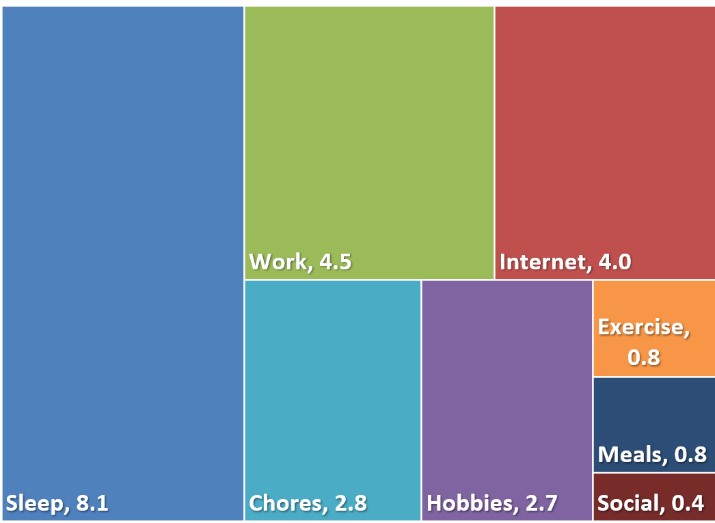
I also was spending far too much time on chores and
housework. I know that sounds nuts, but while
having a tidy house is one thing, and yes, I do want that, puttering around all
day looking for things to put away or clean and listening to audiobooks isn’t
really where I want to put All the Energy. I deserve a nice environment, yes. But I can and should corral that time into
discrete units so that it is taken care of efficiently and doesn’t get out of
hand.
I found that my time was badly scattered
I already knew multitasking is a myth. You’re not multitasking, you’re context
switching. Thing is, if you do that,
you’re bearing a cognitive load.
Numerous
studies point to the fact that as you context switch between tasks, your
efficiency on those tasks, as well as your accuracy, suffers. For work that has a heavier cognitive load, a
flow state is important.
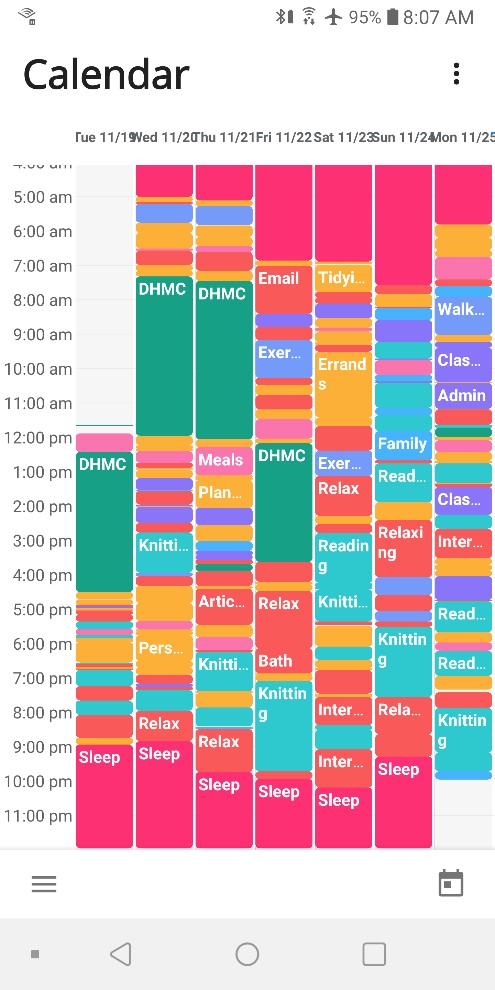
If you take a look at the screenshot, you’ll notice that unless I was teaching a class, sleeping, exercising, or knitting, a lot of my time was spent in context switching.
Now, the reality?
Most housework chores simply don’t take all that much time or cognitive
load. I’ve talked about that before. However,
when you’re switching your attention a lot, you’re not getting as much done.
I am taking away from this particular data that how much
time I dedicate to something does need to depend a bit on the cognitive load
the task takes. Laundry, not so
much. Writing? Learning a new computer
language? I need to stop switching around
and focus.
I was putting too much mental energy into exercise
Look, I need to work out.
I do work out.
I do not need to spend an hour looking for motivational
articles on the Internet about why I need to work out or to get me excited
about my goals. My body does not care
about what it takes to get me on the treadmill or weight bench. It only cares that I did it.
That hour I spend hyping myself up to work out is in no way adding to my life. It would be better-spent knitting. At least I’d get a sweater out of it.
Things I won’t change
Because living on purpose choosing deliberately is a big
deal to me, I’m happy that I got feedback about things I don’t want to change
because I’m happy with what I’m doing.
I spend a lot of time planning or preparing
Straight up, I’m okay with this. It wasn’t a surprise and I was always happy
with spending my time this way. I used
to have a martial arts teacher who consistently said, “Preparation precedes
action.” True. Very true.
Making bento the night before takes about 15 minutes a
night. If I eschew those fifteen
minutes, I am running a non-trivial risk of not making a well-balanced lunch
when I get hungry around noontime. I’m
fine with giving Future Me that little present.
Laying out clothes and tidying while the bath is running (I
have low water pressure) definitely jump-starts my morning, especially when
exercise clothes are staring me in the face on what I know is going to be a
busy day.
Five minutes with my Bullet Journal translates into more
knitting and reading time because I think about what I want to accomplish in a
day and when that’s done, I’m blasted well off the hook for being so-called
productive. I had kinda figured this was
so, but now I have a numeric comparison.
I spend a lot more time reading actual books than I thought
I thought I consumed most stories in audiobook format while
I’m doing household chores these days.
So I figured that the “Reading” part of how I spend my time under
“Hobbies” was going to be a bit anemic.
Naw… Not really. Part
of this is that I read in the bathtub, and I had no idea how long I generally
spent in the bath soaking and reading a book.
I found out that I average about as much time doing that as I do
exercising. Nice balance and a pleasant
surprise.
I get enough sleep.
OK, I already knew that. I’m protective of my sleep and have been for many years. I’m stupid when sleep-deprived, so I avoid that. I find the bragging about running on too little sleep idiotic and I’m sure it contributes to our unstable politics. That, and not making your bed. That’s my story and I’m sticking to it.
So, a question for my readers. Are you satisfied with how you spend your days? If not, what do you want to do and how can you do that?
[1] If
you’ve known me for five minutes, you know about the family thing.
Don’t you hate it when you’re on a special diet and you can’t find a meal out?
I do. It’s one of the reasons I am so dedicated to making bento. Those small one-meal containers have not only been the saving of my pocketbook, but also my diet compliance.
The thing is, it takes a bit of creativity to ensure that you’re getting a good, packable meal that’s within your diet parameters as well as satisfying.
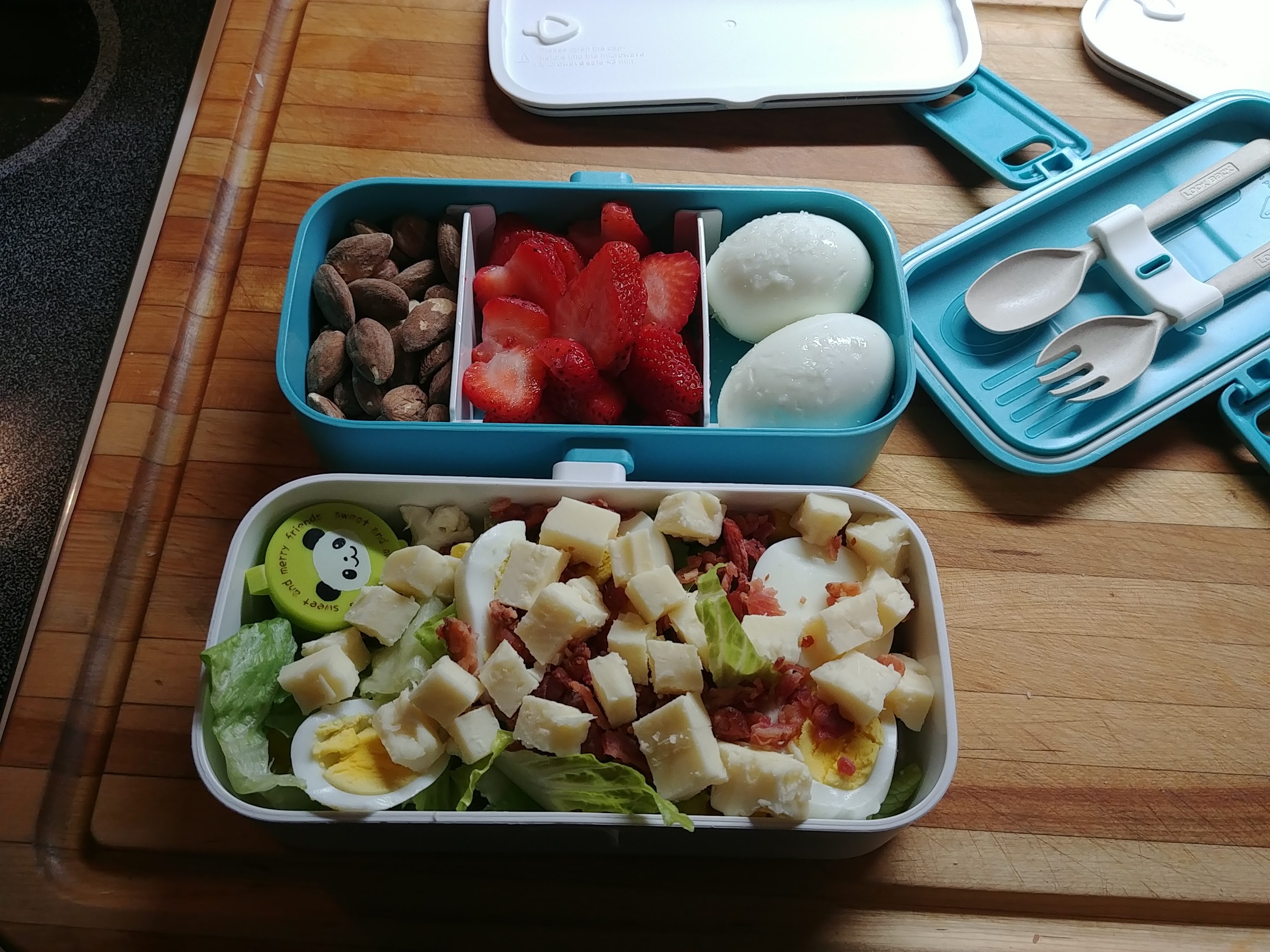
A keto-friendly bento for train travel
I got this particular bento box from Niche for Beach and I adore it. (I also wasn’t paid to write this, though if they wanna send me another such box…) It’s sturdy, has lids that seal pretty well for each compartment, and can go in the dishwasher, which is something of a rarity for bento boxes.
This is much larger than your usual Japanese bento box, but I’m okay with that, as it means you can have a meal with a small salad — something one does a great deal when eating keto. (Yes, people on a keto diet eat their veggies. It’s not all bacon-wrapped fried butter).
When planning a nice, portable keto meal, you need to remember a few things. You need to have enough fats. This meal has some nuts, some cheese, a few bacon bits and dressing for the salad, so that’s all covered. You need to have your protein. In this case, the cheese and boiled eggs cover it. Chicken is also a good thing to use here, as it’s good cold and cooks up easily. You also want to have different textures for a good mouthfeel. For this bento, we have the nuts, the crunch of the salad and the softer textures of the cheese and eggs. Oh, and you want veggies. Salad covers this dandy. For extra nutritional punch, you could add darker greens like spinach and such, but I’m going to admit right here that romaine lettuce is less expensive and lasts longer in the fridge, so that’s what I run with a lot more often.
While strawberries are kind of on the higher end as far as keto-friendly foods, I tend to include them in my lunches, as it satisfied my “dessert” desires pretty well.
If you’re interested in seeing some ideas for good, keto-friendly bento, let me know. I’ll be glad to post more.
Being frantically busy isn’t the same thing as being productive.
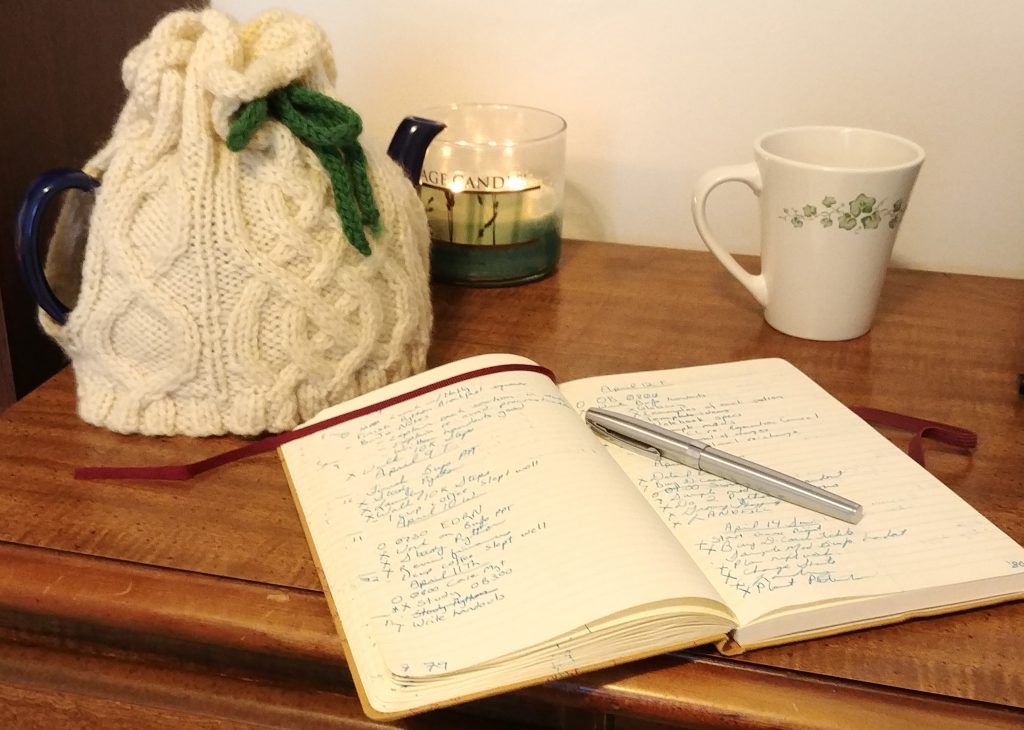
This hit me hard last night when I migrated to a new Bullet Journal notebook last night. My old volume was full.
The migration process takes about an hour. It’s an hour that makes you think.
It
was nice to review the notebook. I can get caught up in the day to day
and forget what I’ve accomplished. The old Bullet Journals, especially
when I am migrating to a new one, are an amazing way to review the past
few months, take credit for what I did do as well as figure out where
I’m falling down on doing what I want done.
As I was migrating, I noticed I’ve not been giving a project the attention it deserves as I was migrating different collections and projects from one notebook to the other. It got me to thinking about how important that project really was. Maybe I need to let it go.
Except…
I migrated the collection about that project. If I took the trouble to hand-write all that stuff, it’s still important. If I let things slide until the next time I migrate, I’d say that’s a clear signal that it’s not something all that important to me any more.
I love that clarity.
I
joke, sometimes, that the Bullet Journal changed my life. It’s
hilarious, but it did. It brought a lot of clarity to not only what I
want, but how I actually spend my days.
I think it’s funny that this little system and notebook, so low-tech, has been so useful to me. I mean, I love gadgets. I love beepy reminders. I love all the new tech. I’m an early adopter as often as my purse allows. You wanna talk “sparking joy?” Tech is it for me.
But that
notebook surpasses it all. The reality is that it works because I am
not consistent. Some days I’m on the ball and focused. Other days, I
am not on the ball at all. Most digital systems don’t seem to allow for
the ebb and flow of my energy the way my Bullet Journal does. Most
digital systems don’t allow for review, don’t allow for a reality
check. You get a snapshot of the present and that’s it.
For all that, yes, living in the moment is a good thing, when your moment is full of self-reproach about how you’re letting your life drift away, or that you never see your family like you want to, being able to review and say, “Well, you took a trip to visit them SEVEN TIMES last year!” or “You completed that course, wrote those articles, sewed that dress, and helped your son out where he needed it” it helps as a reality check, not only for the negative, but for the positive.
Tasks in Outlook don’t help with that.
They don’t show the shape of your days as well. Remember the Milk might
be amazing for scheduling recurring tasks. It’s not so great when Life
Happens.
None of them really encourage things like taking notes on one’s vacation to remember the good times. I mean, sure, sure, I’m an enthusiastic diarist, but in terms of referencing what I’ve done from anything but an in-the-moment rant, the Bullet Journal has it over the things I write in my daily pages.
The biggest power of the Bullet Journal system for me is that things don’t fall through the cracks. It is amazing the amount of time one wastes being reactive and scrambling to catch up.
The problem is I’m so used to things falling through the cracks that I’m still not used to being on the ball to the degree I am now. You wouldn’t think that you’d have to overcome that sinking sensation of “I know I’m falling down and forgetting something” but if you’ve experienced it for forty-odd years, it’s like this weird hole when you realize that no, for the most part, you’re on top of things.
I’m still not used to it, which is, I suppose, why I write about organization with such a sense of wonder. It’s new to me not to be frantically playing catch up on all the things I needed to do. Busy? Hell yeah, I’m often busy. But oh! there is such a difference between being calmly busy and frantically trying to stay on top of things.
I will say that being used to being frantic might give you the illusion of being actively productive.
My Bullet Journal has proved that to be a stinkin’ lie.
I was re-reading a book called Home Comforts yesterday. The author was a lawyer, but really likes being a homemaker better. She approaches it from a professional point of view.
One of the things I found fascinating was something she said in her early chapters — that when you try to organize your home, you need to decide on what you consider an acceptable baseline.
This isn’t what someone else thinks is an acceptable baseline, but what is okay and makes YOU happy. She comments that one of the things she does that is utterly contrary to what a 1950s-trained homemaker would do is allow her child to keep a project in progress out. Everything else needed to be put away, but while the kid is assembling that Lego Helm’s Deep (I pick that as a fairly involved project) putting the toys away doesn’t include putting away that half-built model in her home.
It was an interesting thread to pull.
I think a lot of people who struggle with keeping their homes without shame do is pick a standard that isn’t THEIRS. They don’t have a baseline that’s okay with them. They just see pictures from magazines and homemaking blogs without giving a single thought to how they actually live.
I struggled with this a lot. The house would get untidy and I’d marathon clean so that it was “perfect” then it would get messy and so on.
My baseline isn’t “perfect” (does that exist outside of a staged home for sale?). I was thinking about that as I was tidying a few things away to dust this morning. I had some random stuff that had piled on the dresser in the past few days. You know, things that are certainly out of place but haven’t reached the “mess” threshold in my mind yet. I had a coathanger, a nightgown, my blood glucose meter and sharps bin, a health pamphlet, my Kindle, a water bottle, and a custard cup I’d been using to have a snack of nuts. Staged for a photograph? No. Able to put away quickly enough that dusting didn’t seem like an overwhelming chore? Oh yes.
It was my baseline. It was acceptable to me. I know that FlyLady urges people to try to keep their homes in such a condition that it’s less than fifteen minutes worth of messy — meaning that you could put away clutter in fifteen minutes or less.
That’s not a bad baseline, either. But you know, you could choose anything you wanted, as long as it’s a standard you thought about. It’s the thinking about that’s important.
For instance… Mail on the counter. Is that okay? For my household, it sure seems to be. In tidying up for my Clean All the Things day, yeah, I did toss and shred some mail and file some stuff to take care of. So, a few pieces of mail on the counter is dandy. It gets taken care of in a timely manner.
What about laundry? Some people have a Re-wear Chair. This is a place they set out clothes that they’ve worn, but don’t want to put back in drawers or a closet. Other people have a rule that if it’s clean enough to re-wear, it’s clean enough to put away. What’s your rule?
The idea, and I really liked it, is to set some Official Standard in your mind. Do dishes have to be washed and put away? Just washed and in the drying rack? At least on to soak? What’s YOUR standard and baseline that’s really okay with how you live?
The UFYH author, Rachel Hoffman, encourages anyone sharing space to think about this and have it spelled out. While she’s right that it’s good for anyone living with someone else, I think it’s also good for agreements with oneself.
I also think that setting the bar too high for whatever you genuinely have time for is counter-productive. If you’re anything like me, you won’t be able to hit that bar and won’t do anything. I strongly discourage anyone from setting a standard that would appear in a staged shot for a magazine.
The home is a dynamic place. You LIVE there. Setting an acceptable standard that means you could have some judgy person drop in and have nothing to judge is silly, counter-productive, and frankly pointless. The home should be a safe space, and you need to think about what the environment is that makes you feel safe. That’s going to be different for different people.
I was going to include a picture from my own home and decided not to, as it’s not the point of this little musing. What’s the standard that makes YOU happy and comfortable? My house doesn’t count.
I know perfectly well that those 10,000 steps the fitness trackers push is a fake goal. Know where it comes from?
Back in the sixties, a company in Japan was trying to sell
pedometers. 10,000 is an auspicious
number in the Japanese culture.
Boom, there’s the genesis of the 10,000-step goal right there.
It’s also fashionable lately for articles to talk about this and how 10,000 Steps isn’t a scientifically-based metric for good physical fitness.
Know what? They’re right. It’s not.
It’s not based on any science at all.
Know what else?
I don’t care.
Measurable goals can be useful. I know of one person who never, and I mean never misses her daily walk of about 40 minutes (give or take). Like, never ever misses it. She doesn’t because she has a fitness tracker that gives her a measurable goal. She can see every day whether or not she took that walk.
And you know what else?
Getting in well over 250 exercise minutes a week is absolutely a
health benefit based on scientific research.
So yeah, those 10,000 steps are arbitrary. However, most people who make a specific effort
to get in that many steps are probably taking in a few nice walks every week to
hit that goal.
In my Endless Quest for Tidiness, which is mostly analysis
and musing these days, as my home is absolutely tidy enough, I noticed a
habit of my mother’s in much sharper relief than usual.
She puts things away.
I know, duh! Putting
things away makes things tidy, right?
However, it’s more subtle than I thought.
I noticed it on vacation, of all places. Mom and Dad like to take a morning walk, and
I’d volunteered to get breakfast for the family while they were doing so that
week. My husband loves to get out in the
evenings when we’re at the beach, so I figured our Daily Walk (yes, we care
about that, too) would be a good thing to do in the evenings after dinner.
Before Mom goes to bed, she likes everything to be put away. For instance, in the kitchen dishwasher emptied
of clean dishes, dish drainer empty of dishes that have dried after dinner. She did this while my husband and I were on
our walk.
Now, I wake at first light most days, call it twenty minutes
or so before sunrise. In real life, I might
roll over to sleep some more, but I don’t at the beach. I like to watch the sun rising over the
ocean. It’s one of my favorite sights in
the whole world!
Walking into the kitchen to make a cup of coffee in preparation
for my Morning Ritual was really nice. Everything
was neat and clear and calm, and it just made me feel good.
After coming home from our vacation, I decided I wanted to
try that out in my own life. I told
myself if it was a burden or I couldn’t make it stick, I’d go back to my “never
more than fifteen minutes of messy” style.
It’s certainly tidy enough and no big deal, so it wasn’t like I’d have
this pressure and feel like I failed if I decided I didn’t want to keep it up.
I found out something.
I most emphatically do want to keep it up.
Putting things away every night reduces chances for accidents and property
damage
I have a young cat.
Mr. Tumnus gets into things all the time, as he’s still a very curious
and active little fellow. When I put
things away, the cat doesn’t get into my knitting and scatter my yarn and
project all over the living room.
Making sure I put away my evening cup of tea ensures that when
I get my morning coffee, I’m not risking a spill by my writin’ chair removing the
empty cup from the coaster and replacing it with the mug of hot coffee. I’ve spilled coffee on more than one knitting
project from this little dance of switcheroo.
When I put things away every night, my kitchen stays tidy.
Washing a pot or pan after a meal and always having a
dishwasher ready for the things that can be machine washed is easy. Unless you’re stressed to the point of needing
medical care (and no shame about that, it happens to all of us) rinsing out a
cereal bowl just isn’t overwhelming.
Since we tend to pile mail on the kitchen counter, I also
note that in tidying the kitchen every night, I’m loathe to leave mail piled on
the counter. It goes in the recycling,
shredder, or is dealt with immediately.
Waking up to tidy spaces helps with mental clarity and creativity
Now, I’ve been keeping my room relatively neat for a long
time. But, there would be times when it would get very cluttered. Maybe I’d been slow to put laundry away. Maybe I had a bunch of books I’d been reading
all over the place (less common now that I read electronically). Maybe I’d dropped yesterday’s clothing on the
floor rather than putting it in the dirty clothes hamper properly. Maybe I was in the middle of a sewing project
and was leaving everything out until I had completed the garment. It was never a big deal. Again, never more
than fifteen minutes of messy, so if I took fifteen minutes on my housework day
to tidy the room, it was easily brought back to rights.
I’m in the middle of sewing a dress right now. Just for giggles, and to continue the experiment
that I thought I might drop, I put all my equipment away after completing what
I’d intended to do on it.
For me, I realized that it is easier for me to think calmly
about the project, to take it appropriately slowly when I am not eager to be
done so my daggone room isn’t really cluttered from all the paraphernalia from
the project. Being less likely to rush
means a better quality project that I’m happier with.
Tidying every night reduces work
Back when I lived in a really cluttered home, that sounded crazy. Yes, yes, yes, I grew up in a tidy home, but
tidying my room was always this big daggone production. Surely the tidy spend all their time cleaning
and tidying, right?
Not even close.
I spent four and a half hours sewing on my new dress
yesterday. Putting away all my sewing
stuff took 00:02.38. Yes, less than three
minutes! Yes, I timed it. Yes, I have space to put my stuff away easily
because I’d Konmaried my home about four years ago. So, I guess Ms. Kondo was right about the
whole tidy forever thing. *wrygrin* It’s
just that “tidy” is still a dynamic process.
Which makes sense. One’s home is
a dynamic process, or it should be. You do work, you get things messy, you put
things away. We all do it. It’s just that making the cycle more rapid makes
things easier.
Friends, if you take a look at home much time I spend
writing, knitting, working, playing video games, working out, or sewing, any
one of those items will take more time in a week than I spend on cleaning by at
a minimum of a factor of two.
So, yes, I am going to keep the practice (which I hope to
develop into a habit) of putting everything away and “rebooting” my house every
night.
Why?
I have better things to do than tidy all the time.
It’s not a secret that I love trying out life systems and self-improvement ideas. And Goodness knows it’s a weird hobby. Flylady, Konmari, Everyday Systems, Bullet Journals, you name it. I find these things interesting and enjoyable to play with.
That’s the thing. I’ve begun to look at it as a hobby. Not every system I’ve tried has necessarily produced the results I wanted, but you know what?
Some have. My homemaking skills are a lot more Flylady than Konmari, but wow was keeping my home tidy easier after I did the big ole tidying “festival” Marie Kondo suggested.
I like listening to self-improvement books when I walk alone.
None of this has exactly made me a paragon of virtue or excellence, mind. I’m not rich. I’m not skinny. I’m not famous. *wrygrin* My view of the improvement of the Self even questions how in the world these three big goals seem in any way to be listed as self-improvement.
Fine, your house is tidy now. But do you treat people kindly?
Okay, you’re rich. How did you get that way? Were you honest? Were you able to keep your integrity?
Great, you’re skinny. Is this a virtue?
Things I think would be better addressed in self-improvement literature:
What is your word worth?
How’s your compassion?
Do you have good boundaries and how do you enforce them with kindness?
What do you see as your duty, and do you fulfill it? If not, what’s stopping you?
Not ONE self-improvement book I’ve seen discusses these topics much. Though, Marla Cielly of Flylady fame and Reinhard Engels of Everyday Systems seem to strike me as people to whom integrity and kindness seem to mean something.
But most of the so-called self-improvement literature I see is a lot less about becoming virtuous and a lot more about becoming inappropriately selfish. I say “inappropriately” because boundary setting can look selfish to someone wanting to take inappropriate advantage of you.
Few of these books discuss one’s duty to oneself and one’s fellow humans.
I think these questions are considerably more important than whether or not you have enough self-discipline to stick to a diet. For my own part, I find sticking to a diet a lot easier than being patient with strangers who frustrate me, speaking up about an injustice, or setting appropriate boundaries with people whose real motive is to use me as a thing or resource.
I think being a size two, being well-known or having a big bank account is trivial compared to that.
And I find it interesting that the self-improvement industry is largely silent on it.
Just sat down with my Bullet Journal, as I do every Sunday, to plan out the next week.
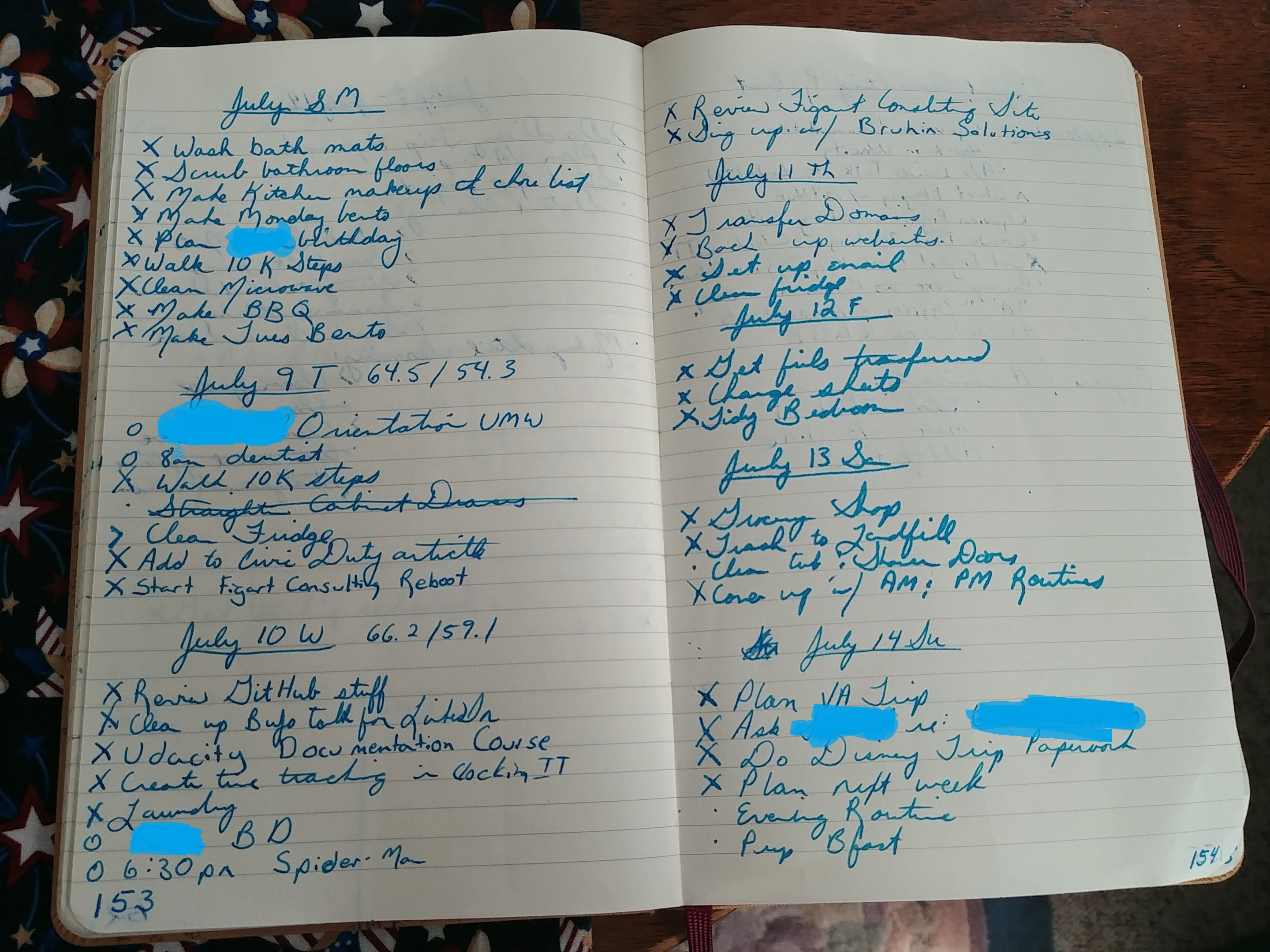
I do this for a lot of reasons. I want to make sure I’m following up on everything I need to. It is very easy to allow things to fall through the cracks. This helps prevent it. I cannot say I always follow through on everything in exactly a timely manner. I don’t. Without something to keep me on track, I’ll follow my whims. That gives me about a 15% accuracy on my Get the Important Stuff Done score. When I use a tracking system of some sort, that brings the Get Important Stuff Done score up to between 75% and 90%.
Beepy reminders are usually at about a 75%. That’s still not bad at all, mind. But it’s stressful.
Sometimes I get tired, or depressed or whatever, and to be quite frank, I do not necessarily jump on everything I think needs to be done. A beepy reminder gives you a window of RIGHT NOW to do it before it falls off your mental radar. That’s fine when I’m all happy and motivated and shit.
I am not always all happy and motivated and shit.
The Bullet Journal brings me more up to that 90%, which is as good as it is ever going to get. One of the nice things about my Bullet Journal is its flexibility. The Bullet Journal means that I get more Important Stuff done while actually being less immediately on the ball. It’s forgiving. It’s imperfect. Things get crossed off when I decide it’s not Important Stuff after all.
If I lose interest in a self-assigned project, I have the material to circle back to it if I need to. It makes me less obsessed.
If I’m procrastinating on something I REALLY have to do, consistently migrating that task day by day does poke me to get it off my plate better but feels less emotionally fraught to me somehow. It’s there. I need to do it, but I can migrate it to tomorrow. You know what? It still gets DONE. That’s cool.
If I am Just Not Feeling It, the Bullet Journal waits quietly and without judgment until I go back to it — all necessary information and plans there. With most task management software, an overdue task turns red, or keeps beeping at you and making you feel bad in a way that the Bullet Journal doesn’t (at least for me).
I love the imperfection and messiness of my Bullet Journal. It helps me Not Waste My Life, but still allows for the dips and swells in my emotional energy. It’s such a beautiful reality check for me. When I start feeling badly about myself, I can look and see how I’ve been spending my days. I can sometimes feel like “I’ve gotten nothing done” and when I look back, I realize that no, I PLANNED to play that video game. It was on purpose, so that time was not wasteful.
Yes, I put more than chores in my Bullet Journal. For me, that’s part of what makes it such a wonderful reality check. Am I getting Enough Done? is certainly an important question. So is Am I doing things to recreate and enjoy myself? Did I do the laundry, pay the bills, and get to the dentist? Great! Did I take a walk, play a video game, or knit or see a movie? That’s important, too.
I think it helps me keep things in balance. The reality is that I have no middle gears, and am appallingly bad at moderation. I tend to want things to be perfect and have been known just to give up when I can’t do that. There’s a time and a place for shooting for perfection, certainly, though I’ve had it pointed out that shooting for excellence rather than perfection makes more sense.
Excellence is different from perfection. Excellence means you’re consistently striving for better. Excellence isn’t binary — either meeting the mark or not. It’s not a pass/fail proposition, but a fairly consistent effort. It cannot ever be “perfect” and even accepts that there is always something else you can do.
This is hard for me because I tend to be binary in my thinking. Of course, I do. It’s EASY to think in binary terms. Okay, that’s fine and even appropriate for some endeavors, but it really doesn’t reflect the realities of an entire life. There’s no such thing as a binary human life.
Which is exactly the point of the imperfection of my Bullet Journal.